
Ada County Wanted Fugitives Explained
The Ada County Sheriff’s Office runs a public warrant tool. It is the best local place to start. Go to the ACSO warrant portal and enter a first and last name. The form covers valid ACSO traffic and criminal arrest warrants, plus most warrants the Ada County District Court has issued. Juvenile cases are left out. Updates roll in through the day, though very recent changes can lag behind the paperwork. Keep expectations realistic. This is a wanted-status check, not a full county history. It is also not a substitute for the jail roster, which shows who is in custody right now.
Do not expect a glossy Most Wanted wall. Nothing like that exists here. There is no published headcount, photo schedule, or reward list anywhere in the county systems. What exists is this working search form, built for a targeted name check rather than browsing. A match can also shift after a court action, a recall, or a correction lands before the page refreshes, so treat any result as a snapshot of one moment. The screenshot below shows the search interface itself. It is a form with fields and caution language, not a gallery of faces, and the official warrant form is intended for exactly that narrow purpose.
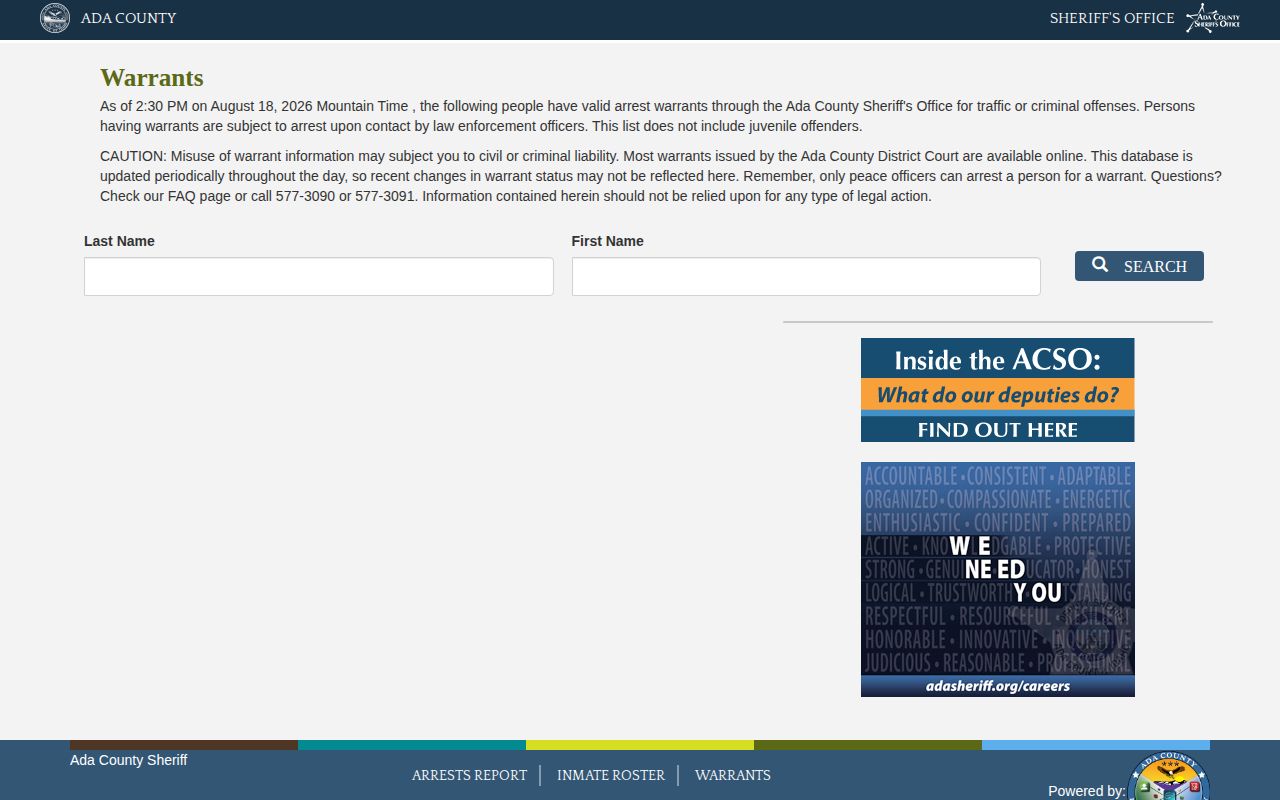
Know what a hit actually tells you. A warrant result reports wanted-status information only. The form does not display a booking photo, and it says nothing about current custody or a filed charge. For those answers, the jail roster and court records are the right tools.
Ada County Warrant Portal Limits
Read the portal's own wording closely, because it draws the boundaries. The site describes valid ACSO warrants for traffic or criminal matters and most District Court warrants. That is not the same as every warrant from every agency or court in the region. Juveniles are excluded again here. So a missing name proves nothing about legal standing, and a listed name proves nothing about an arrest. Both readings overreach.
Timing matters too. Updates arrive periodically rather than instantly, and the source itself warns that fresh warrant changes may not show up yet. It also warns against relying on the data for legal action, since misuse can carry civil or criminal consequences of its own. Need a legal answer? Call the issuing court or a lawyer. Need a custody answer? Go to the jail or the law-enforcement office handling it.
This tool gets confused with three other systems. Keep them straight. It is not the current Ada County Jail roster, not the recent-arrest feed, and not a court docket. Each one answers a different question. Someone can have an active warrant while walking free. Someone else can sit booked in the jail without ever appearing in a warrant search. Status shifts fast, sometimes faster than either public interface can record.
Ada County Warrant Fields
Stick to the fields the ACSO form actually gives you. It is a name search, not a photo archive. The labels matter. They keep a warrant entry distinct from a booking record and from whatever the court case later becomes.
| Field or feature | What it tells you |
|---|---|
| First name | The first-name search value entered in the ACSO warrant form. |
| Last name | The last-name search value used to narrow the warrant results. |
| Warrant scope | Valid ACSO traffic or criminal arrest warrants, plus most warrants issued by the Ada County District Court. |
| Juvenile handling | Juvenile offenders are excluded from the public warrant list. |
| Update note | The portal is updated periodically through the day, but recent changes may not yet appear. |
| Legal meaning | A result is warrant-status information, not proof of arrest, custody, a sustained charge, or guilt. |
| Photo status | The inspected form is not a booking-photo gallery and does not establish that a photo is available. |
Read a result narrowly. Match the name with care. Weigh the portal's stated scope and warnings, then take any legal question straight to the issuing authority. A row in a public search cannot tell you where a person is, what they did, or how a case ended.
How to Check an Ada County Warrant
A name check answers one thing: whether the public ACSO warrant source returns a match. It cannot confirm identity on its own. It also cannot replace an attorney, a court clerk, or confirmation from law enforcement. Keep the search tied to a real records question, and never treat a result as a reason to confront the person yourself. That is a job for officers, not the public.
Check sequence
- Open the official ACSO warrant portal and read its scope and caution language before entering a name.
- Use the first-name and last-name fields. Compare the returned information with facts that lawfully identify the right person, rather than assuming every matching name is the same individual.
- Read the result as a warrant status. The portal covers the ACSO categories it describes, most Ada County District Court warrants, and no juvenile offenders.
- Allow for timing limits. The list is updated periodically, yet recent changes may not be reflected when the search is run.
- For a legal question, contact the issuing court or an attorney. For a safety concern, use an official tip line or emergency services instead of approaching anyone.
- Keep the result separate from a booking photo, a jail roster row, and a court disposition. Those records answer different questions.
Wondering whether an Ada County arrest turned into a county booking? The official booking and roster path runs through the Ada County records search. Read each result for what it is. A roster hit means current listed custody, not that a warrant caused it. An arrest-feed hit means a recent processed event, not necessarily someone still behind bars.
Ada County Warrant Types
Terms like “arrest warrant” and “bench warrant” carry precise legal meanings. A short search result cannot unpack what the issuing judge actually ordered. For the substance behind any entry, the issuing court or your counsel is the only reliable stop.
- Arrest warrant
- A court-authorized direction that permits law enforcement to take a named person into custody under the stated legal basis.
- Bench warrant
- A warrant issued by a judge in connection with a court matter, often after a missed appearance or an alleged failure to follow a court order. The exact reason belongs to the court record.
- Warrant status
- The public result that an agency or court record reports at the time of the search. It is not the same as a custody status or case disposition.
These definitions are broad. They won't tell you which type attaches to a specific Ada County entry. Warrants get served, recalled, quashed, or modified, sometimes before any online list catches up. For hearings, pleas, judgments, sentences, or a dismissal, the court file is the place to look.
IDOC State Supervision Fugitives
Idaho runs its own wanted list for people under state supervision or IDOC jurisdiction. The IDOC Fugitive Recovery page belongs to the Department of Correction's Special Investigations Unit. It is not the Ada County Jail roster. It isn't a county booking feed either, and it doesn't replace the ACSO warrant portal. A state list of this kind can carry fugitive matters tied to supervision rather than to any recent county booking.
Tips can reach IDOC by web or phone. The listed numbers are 208-658-2167, 208-343-COPS, and 1-800-222-TIPS. There is also the anonymous 343 COPS tip site. Use those channels to pass along what you know about a wanted or fugitive person. They won't confirm a booking photo, check a jail bed, or speak to how a charge turns out.
The image below shows the state-supervision source itself, not county booking photos. Read the agency label first. An entry only matters to Ada County if it says so.
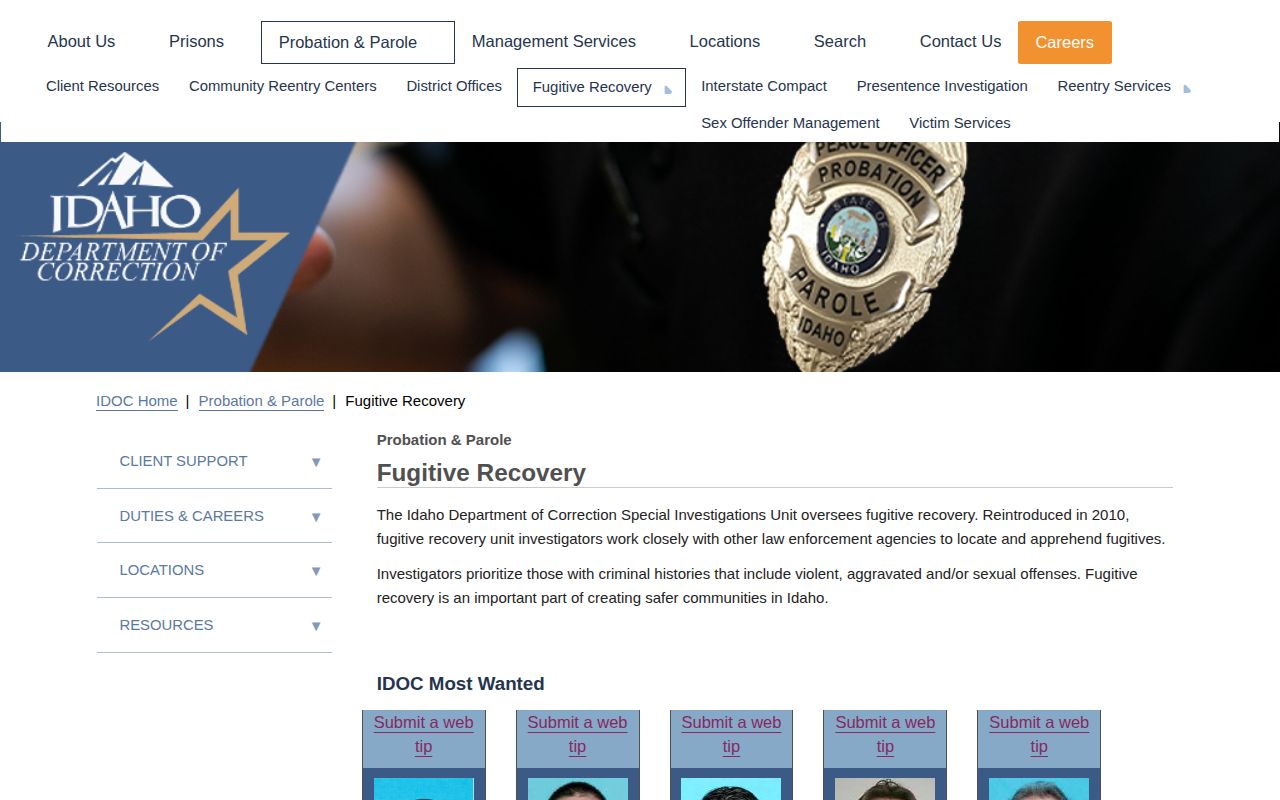
The IDOC page exists for one purpose: fugitive recovery under state supervision. Expect it to carry that label, even when the person listed has an Ada County connection.
Ada County Alerts and Tips
ACSO publishes Android and iOS apps built for alerts and tips. The store descriptions point to road closures, safety and weather notices, event information, anonymous tips with photo, video, and GPS, and links to sheriff resources. Neither app offers an inmate lookup. Neither one carries a booking-photo feed. So an app alert can't stand in for the arrest report, the roster, or the warrant form.
The sheriff's office also posts selected items through Facebook and X/Twitter. No fixed booking-photo schedule governs those accounts. ACSO policy permits routine arrest releases as a public-information topic, and the Community Information Unit decides how often and about whom. Treat social posts as highlights. They are never a full warrant or arrest index.
One more channel exists. The ACSO current-arrests report can carry a VINE notification link. Idaho court materials describe VINE and SAVIN sign-up through VINELink or 1-866-9VINE-ID for custody and court alerts where the service runs. A notification service sends status alerts. It is not a photo archive. Availability and agency connections shift over time.
Ada County Court Follow-Up
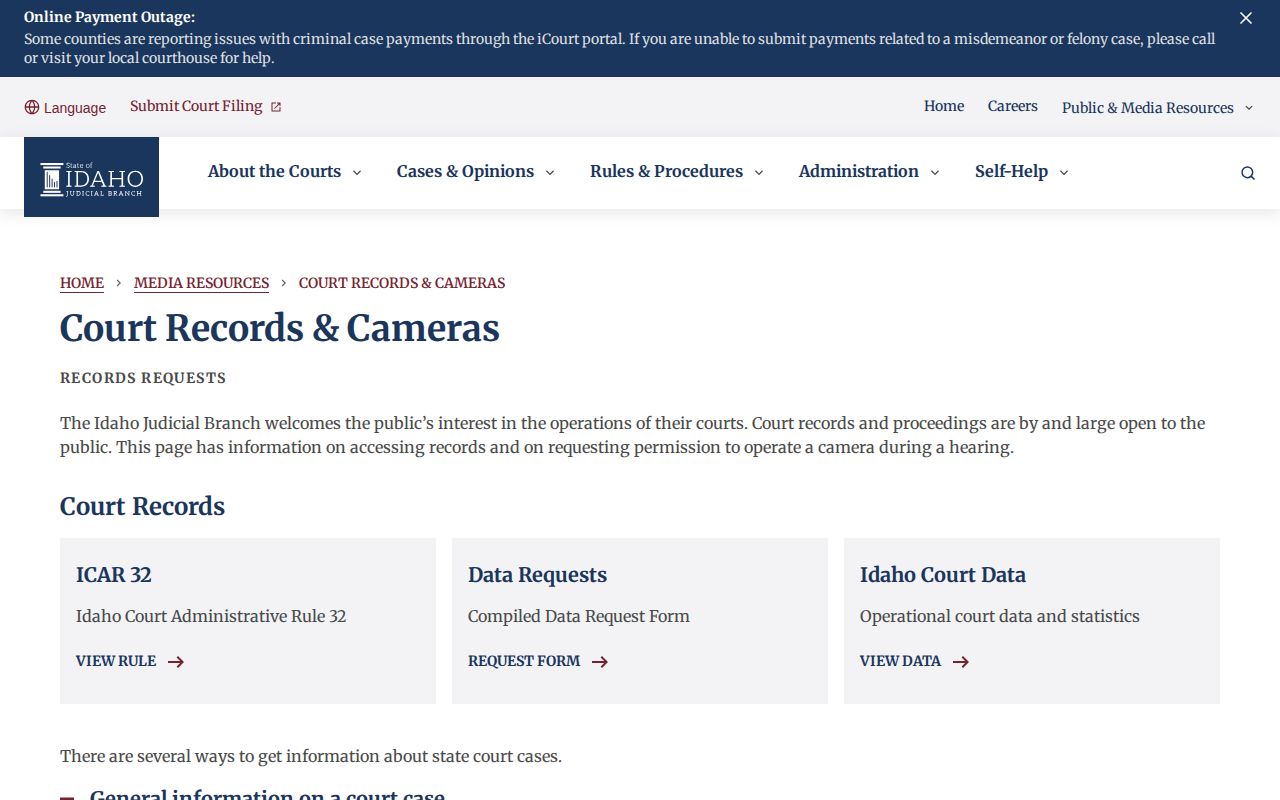
When the question is legal status rather than public visibility, a warrant entry calls for a court check. Start at the Idaho iCourt portal, the statewide hub for case records, hearings, and payments. The Idaho Supreme Court records guidance explains that public case material can be searched through iCourt and pulled at a courthouse kiosk or clerk's office. Sealed files stay out of an ordinary public search. So does material exempt under Idaho Court Administrative Rule 32. An order-to-seal entry can linger in view even after the underlying record is restricted.
Don't mistake the court interface for a booking-photo roster. It may show filings, hearings, pleas, judgments, sentences, probation, dismissal, or another disposition. No hour-by-hour Ada County schedule links booking to arraignment. Someone can leave current custody while the case runs on. A roster disappearance settles nothing about the case itself.
The court-access image below points to records guidance, not photos. It shows the line between an open case search and material that needs a clerk or an authorized request.
Use this order when following an entry toward a disposition:
- Search the person’s name in iCourt and narrow the result with Ada County, a party name, case number, or hearing information.
- Compare the arrest date, agency, and charge wording with the court filing. A booking row and a court count do not have to match word for word.
- Read the case events for filing, initial appearance, arraignment, plea, dismissal, judgment, sentence, probation, or another disposition.
- If the public portal does not show the document, ask the Ada County clerk or use the courthouse record-access route. Sealed and confidential material follows its own rules.
- Keep the warrant, booking record, and court disposition as separate source categories. The later disposition is the proper way to describe what happened in court.
Warrant Safety and Innocence
A booking record and a news item carry the same limit. Charges can be reduced, dismissed, acquitted, or resolved in another way. A public listing can also be stale or incomplete. The presumption of innocence remains in place unless and until a court enters a legally meaningful result.
That rule protects both public safety and the accuracy of the record. Tip channels are for law enforcement. Legal questions belong with the issuing court or counsel. A third-party photo or copied text cannot answer either question.
Ada County Warrant Contacts
For anything involving the county warrant portal, current county custody, or an Ada County record request, the ACSO office is the right first call. Reach emergency services if there's an immediate threat. Keep legal questions away from the warrant form and the tip line.
Ada County Sheriff’s Office
7200 Barrister Drive
Boise, ID 83704
Main: (208) 577-3000
Non-emergency: (208) 377-6790
Warrant questions: 577-3090 or 577-3091
ACSO displays the warrant question numbers without an area code. An answer straight from the office beats an old screenshot or a copied result, especially after a court action or a recent change.